
Insulin pen needle storage: keeping fresh and used needles safe
If you inject insulin, you have two small storage jobs every day. Fresh pen needles need to stay sealed and findable. Used ones need somewhere safe until the sharps bin. At home that's one problem; at work, school or on holiday it's another. Here's how people handle insulin pen needle storage, what each way is good at, and where it falls short.
Why it matters
Two habits cause most of the trouble. In a worldwide survey of more than 13,000 people who inject insulin, about half said they reuse pen needles, and around 30% had lipohypertrophy, the fatty lumps at injection sites linked with reuse and poor site rotation. In the same survey, 40% said their used needles ended up in household rubbish.
Source: Frid et al., 2016, Mayo Clinic Proceedings.
UK guidance is clear on both: pen needles are single use, and used needles never go in the household bin. Sharps bins are available on prescription or from a pharmacy; a full one is sealed and collected or dropped off, depending on your council.
Use a Lilly KwikPen? Which needles fit it, what size and where to buy them are in needles for the KwikPen.
Source: Kent Community Health NHS Foundation Trust, Disposing of sharps safely.
So the question is: between the box of fresh needles and the sharps bin, where do the needles live?
Just starting out? Starting injections: the kit you need is the short list.
1. A dedicated case: NeedleBay
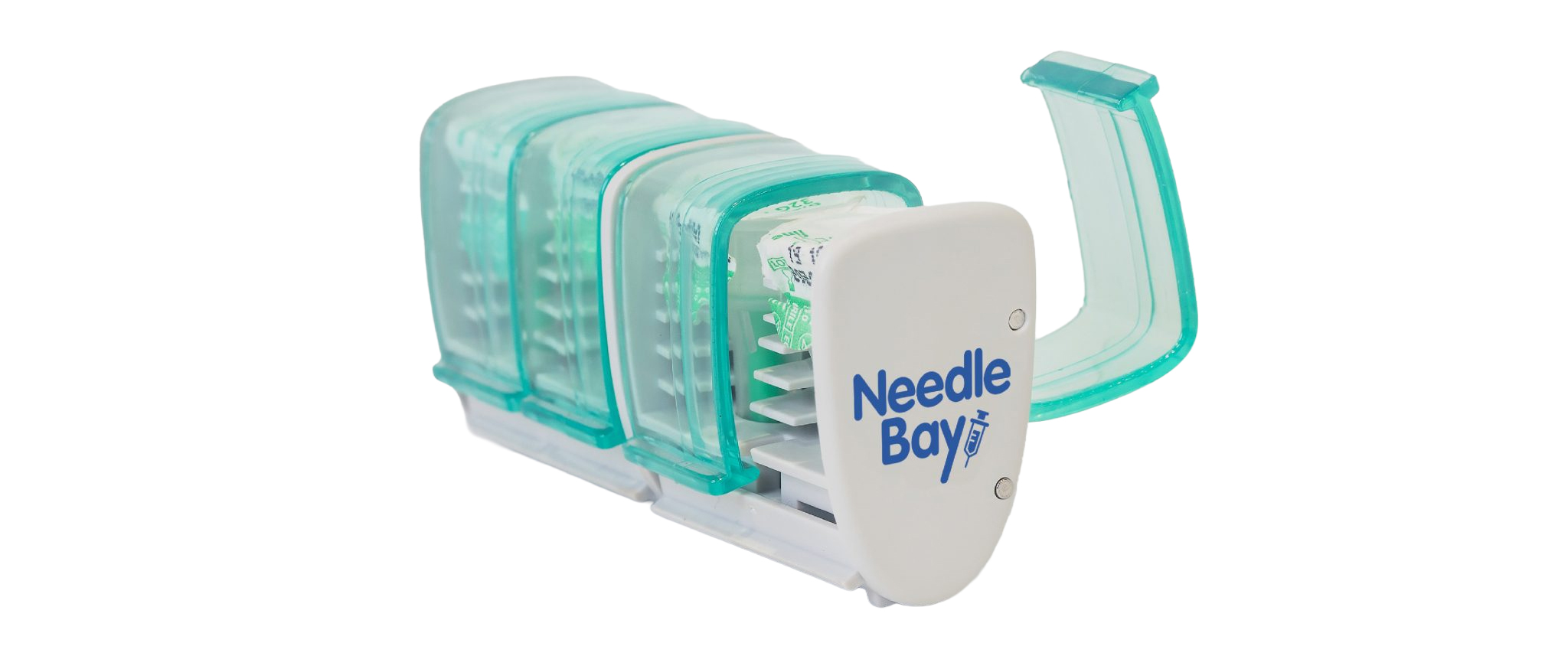
What it is: NeedleBay is a small case with four bays. You load four sealed pen needles in the morning. To inject, you screw your pen onto a fresh needle and lift it out; afterwards you screw the used needle back into its bay and unscrew the pen. The used needle stays locked in the case until you release it into your sharps bin.
Good at: it does both storage jobs in one. Fresh needles stay sealed in their bays, used ones are held securely, and nothing loose rattles about in your bag. The needle stays in its bay while you fit and remove it, so there's no tiny needle to grip and no re-capping. A look through the see-through lids shows which bays hold a used needle, so it doubles as an insulin reminder. It's purely mechanical: no batteries, nothing to charge. It works with the pen needles you're already prescribed, including BD Micro-Fine, NovoFine, mylife and GlucoRx.
Falls short: it holds four needles, so on more than four injections a day you'd carry two. It isn't a sharps bin; you still need one at home to empty it into. And it's a purchase, where the box and the pouch are free.
2. The original box
What it is: fresh needles stay in the box they came in, and you take one as you need it.
Good at: free, and the needles stay sealed. At home, with the box in a drawer, it works.
Falls short: it doesn't travel well and tells you nothing about what you've used. It gives a used needle nowhere to go, so people re-cap it (which guidance says not to do) and pocket it until they get home.
3. A pouch or wash bag
What it is: a zipped pouch holding the pen, a few fresh needles, test kit and whatever else.
Good at: everything in one place, and it goes in a handbag or school bag.
Falls short: fresh and used needles end up loose in the same pouch. A used needle rolling about in a bag, even re-capped, is how carers, cleaners and children get stuck. And it can't tell you which doses are done.
4. A small portable sharps bin
What it is: a pocket-sized sharps container for used needles only, carried alongside your pen.
Good at: it solves the used-needle problem properly. The needle goes straight in and stays there until you empty it into the main bin.
Falls short: one more thing to carry, and getting the needle off the pen and into the bin is still a hands-on job, the fiddly step for stiff or shaky hands. Fresh needles still need their own home.
Needle clippers used to be an option for this, but they have become hard to get in the UK. NeedleBay holds the used needle whole instead, so there is nothing to clip.
At home, at work and away
At home: a sharps bin, kept out of children's reach, is the one thing everyone needs. Whatever else you use, the used needles end up there.
At work or school: the aim is no loose needles, fresh or used, in a bag or desk drawer. A portable sharps bin or a dedicated case does that; a pouch on its own doesn't.
Travelling: carry more needles than you need, and bring your sharps home in something sealed. A case holding the day's needles, fresh and used, makes airport bags and hotel rooms simpler.
Used needles out and about
What everyone does with their used needles when they are out and about is one of the oldest questions on the UK diabetes forums, and the honest answer is that most people improvise. The makeshifts come up again and again: a test strip pot, a tissue and a ziplock bag, an old glasses case, the needle’s own cover. They work until they do not. Guidance asks you not to put the cover back on and not to bend the needle, and a tissue gives it nothing to stay in. NeedleBay is the tidier version of the same idea: the used needle screws back into its own bay and locks there until you reach a sharps bin.
A case for spare pen needles
Spare needles need a home too. Carry four or five loose in a handbag and they get tatty, the seals rub, and you cannot find one when you want it. A case for spare pen needles keeps each one sealed in its own bay, so you take the one you need and the rest stay clean. NeedleBay holds four, which covers a day on four injections or a month on a weekly pen. It is a case for the needles, not for the pen.
Frequently asked questions
Can I keep used pen needles in my bag until I get home?
Only in something made for it. A loose needle, even with its cap back on, can stick whoever next puts a hand in the bag. A portable sharps bin or a case that locks the used needle in place is the safe way.
How do I get a sharps bin in the UK?
Ask your GP for one on prescription, or buy one at a pharmacy. When it's full, seal it; your council or pharmacy will tell you whether they collect or where to drop it off. Never put a sharps bin or loose needles in household rubbish.
Is there such a thing as a travel sharps bin?
Yes. Mini and travel sharps bins are sold by pharmacies and online, and some people are given one by their surgery. NeedleBay is the pocket step before it: up to four used needles lock in their bays while you are away, then drop into the sharps bin when you are back. It is not a sharps bin and does not replace one.
How many pen needles should I carry for a day out?
One per injection plus a spare or two. If you inject four times a day, that's four to six. A NeedleBay holds four, so for a long day some people carry two.
Does storing needles in a case keep them sterile?
Yes, as long as they stay in their seals. Pen needles are sterile until the seal is peeled, so a case that holds them sealed until the moment of use, like NeedleBay, keeps them as sterile as the box did.
Is there a box for insulin pen needles?
Yes. NeedleBay is a pen needle box, or holder, with four bays, each with a clear lid: fresh needles stay sealed, used ones lock back in their bays until the sharps bin, and one look shows which doses have been taken. The original cardboard box keeps needles clean but gives you nowhere safe to put a used one.
Where should I keep my insulin pen?
Your pen’s leaflet says: usually unopened pens in the fridge, the pen in use at room temperature, away from heat and sunlight. NeedleBay holds the needles, not the pen, so it sits beside the pen in your bag or on the shelf wherever you inject.