
Type 1 diabetes at school: managing insulin through the day
Sending a child with Type 1 diabetes to school is a leap of faith. For six hours a day their insulin and their lunchtime dose are in other people's hands, or their own small ones. This guide is for parents and the staff they work with, on how a child's insulin routine can run at school without you being there.

What the school has to do
In England the law is on your side. Under the Children and Families Act 2014, schools must support pupils with medical conditions, and the Department for Education's statutory guidance says how. Three lines matter most:
Schools must not "require parents, or otherwise make them feel obliged, to attend school to administer medication or provide medical support to their child."
Your child should have an individual healthcare plan, "drawn up in partnership between the school, parents, and a relevant healthcare professional", usually the paediatric diabetes specialist nurse.
"Children should know where their medicines are at all times and be able to access them immediately", and "sharps boxes should always be used for the disposal of needles."
Source: Department for Education, Supporting pupils at school with medical conditions, 2015.
Scotland, Wales and Northern Ireland have their own frameworks, but the principle is the same: the school supports the child, and the plan says how. Diabetes UK's position is blunt: "No parent should be relied on to go into school to treat their child's diabetes."
Source: Diabetes UK, Make the Grade schools pack.
There are a lot of these children: in 2024-25, 35,801 children and young people were receiving diabetes care across England, Wales and Jersey.
Source: National Paediatric Diabetes Audit, 2024-25.
The lunchtime dose
For a child on injections, lunchtime is the moment that matters. As Diabetes UK puts it, "children taking MDI will need an injection with each meal", so there is a dose to be given in the middle of the school day, every day, by the child, a trained member of staff, or the two together.
That raises the questions every parent asks. Where is the kit? Who checks it was done? Did anyone get stuck on a needle? And the one that keeps parents awake: did they actually have it?
The school kit
Most children carry a pouch with the pen, a few needles, hypo treatment and a meter. The plan should say where it lives and that your child can reach it at any time. Two things in that pouch deserve more thought.
Fresh needles: loose in the bottom of a bag, they get grubby, go missing, and a young child can't always tell a fresh one from one that's been used. Keep them sealed and in one place.
Used needles: the guidance says a sharps box, always. In practice a child doesn't want to carry a sharps bin round the playground, and a used needle re-capped and dropped back in the pouch is how a teaching assistant or a classmate gets stuck. Whatever you choose, a used needle should never be loose.
A visual check staff can read at a glance
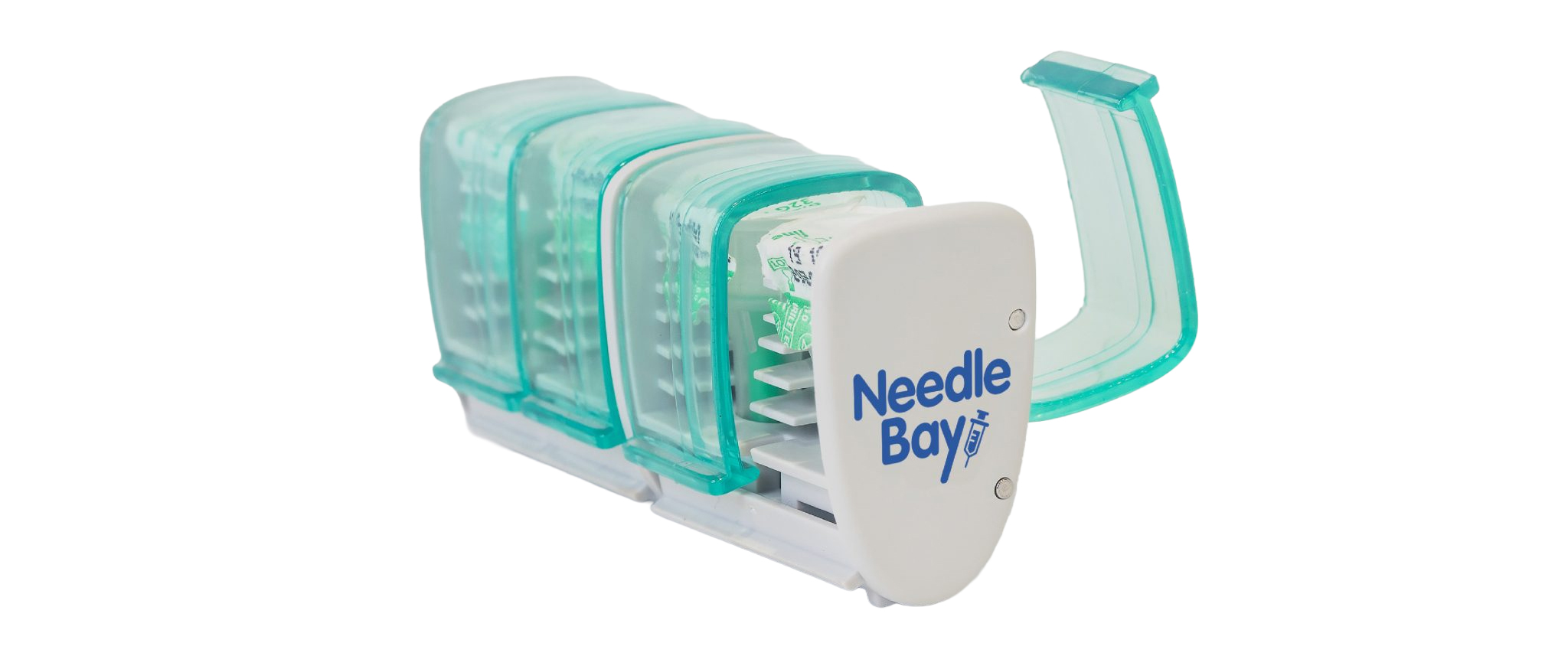
"Did she have her lunchtime insulin?" gets asked by a lunchtime supervisor, a form tutor at registration, and you at the school gate. A method that answers it without a conversation helps everyone.
Some schools use a tick sheet in the plan folder. Some use an app on the child's phone. Our guide to insulin reminders compares the main types. Both depend on someone writing it down at the time.
NeedleBay is a small case that holds the day's pen needles, one per bay. Your child, or the staff member helping, screws the pen onto the fresh needle for the lunchtime dose, then screws the used needle back into its bay. A look through the see-through lids shows a used needle in the lunchtime bay, and that's the answer. There's nothing to write, nothing to charge, and no app that needs a phone the school may not allow. The used needle stays locked in the case until it's emptied into the sharps bin at home, so there's no loose needle in the bag. Our insulin pen needle storage guide compares the options. The needle stays in its bay while it's fitted and removed, so small hands never grip it, and the lids click shut. It works with the pen needles your child is already prescribed, including BD Micro-Fine, NovoFine, mylife and GlucoRx.
It isn't a substitute for the care plan, or for a trained adult. It's a way for that adult, and for your child, to see the day's doses at a glance.
Getting the plan right
Ask for the healthcare plan before term starts, with your diabetes nurse's help. Make sure it names the trained staff, where the kit is kept, what happens at lunch, who checks the dose was taken, and where used needles go. Then ask about school trips, after-school club, and the day the trained person is off sick. Those are where things slip.
Frequently asked questions
Do I have to go into school to give my child's insulin?
No. In England the statutory guidance says schools must not require or oblige you to. The school should have trained staff, named in your child's healthcare plan.
How does a teacher know my child has had their lunchtime dose?
The plan should say who checks and how. A visual method is the simplest: a tick on a sheet, or, with NeedleBay, a used needle sitting in the lunchtime bay that anyone can see without asking.
Where do used needles go at school?
Into a sharps box, never a bin or a pocket. If carrying a sharps box isn't practical, a case that locks the used needle away, like NeedleBay, keeps it safe until it reaches the sharps bin at home.
Can my child do their own injection at school?
Often, yes, with supervision set out in the plan. The guidance encourages children who are competent to self-manage. A trained adult should still be on hand, especially for younger or newly diagnosed children.